

Dry Eyes — A Complicated but Treatable Problem
Most of us have experienced dry eye symptoms. Eyes get scratchy and red, vision may become blurry, it may be tiring to read. As we age, though, occasional bouts of dry eye symptoms can become more frequent, or even chronic. Dry eye disease affects around 1 in 5 older adults, so it's pretty common. Let's talk about why it happens and what you can do about it.
Why do eyes dry out?
You may be surprised to learn that tears aren't just salty water. They're an intricately balanced system of protection for the eye, and they have three distinct layers.
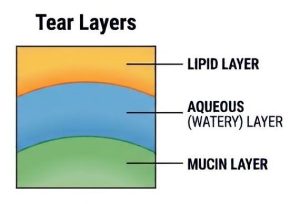 First, there's a layer of mucous (called the "mucin" layer). It helps the liquid stick to the eye and form a consistent film for protection. Mucin is made by cells inside the eyelid and on the white of the eye.
Then there's the watery part -- the part we think of as a tear. It's made up of water, salt, and other substances that help keep the eye clean and healthy. The watery part is produced by the lacrimal gland, which sits right above the eye.
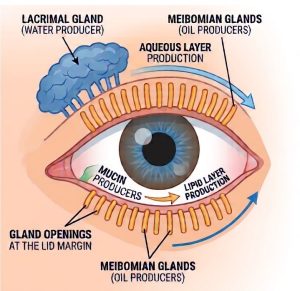 On top of all that is an oily (lipid) layer, which keeps the watery portion from evaporating. This lipid layer is produced by glands located near the edges of the upper and lower eyelids. Interestingly, blinking is what causes the glands to secrete this important tear layer.
You can imagine that anything that disrupts this intricately balanced system can cause trouble. And it turns out that a malfunction in any of the tear-producing steps can a vicious cycle that's hard to stop.
When water in tears evaporates, it leaves behind the salt and other dissolved ingredients. With less water to dilute them, those substances are now more highly concentrated, and very irritating to the eye. And that irritation damages the eye's ability to produce both the mucin layer at the bottom of the tear and the lipid layer on top. Now tears can't form a consistent film over the eye. At the same time water in the tear is even more likely to evaporate. And so the cycle of evaporation, irritation, and decreased mucin and lipid production goes on and on.
What can you do to minimize discomfort?
Start by looking at things that might be worsening your symptoms.
-
Medications -- Quite a few medications (both prescription and nonprescription) can worsen eye dryness. Be sure to have your pharmacist look at your med list!
-
Be intentional about blinking regularly -- Many things we do - driving and screen time among them - force us to keep our eyes open. But when we blink, we help our eyes produce the top layer of the tear.
-
Think about your environment -- Fans, windy conditions, second-hand smoke, and dry indoor air quality can cause tears to evaporate more quickly.
-
Treat blepharitis -- Blepharitis is an inflammation of the eyelids that can cause dry eye symptoms. Ask your doctor to take a look. It often responds well to regular eyelid cleaning.
-
Try a warm compress -- Hold a clean, warm washcloth to your eyes for several minutes a couple of times each day. The warmth helps unclog the glands that secrete the oil your tears need.
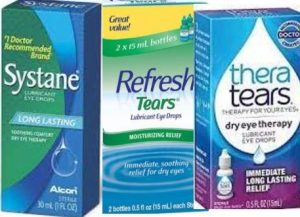
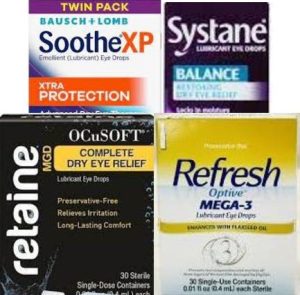
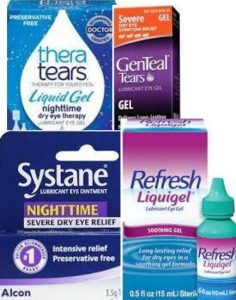 There are also gels. Gels are thicker than liquid drops, so they stay on the eye quite a bit longer than the more watery drops. These can cause blurred vision too, and it may last up to 15 minutes - a bit longer than the oil formulations. But they're safe to use during the day as long as you're careful.
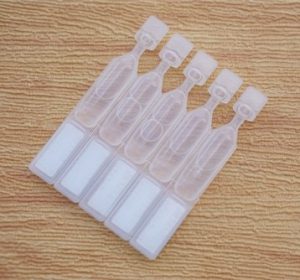
Sadly, I became afraid of eye drops many years ago.. There was a bacteria or something in the drops that caused people to go blind. Do you remember that time?
Good to hear from you Tony — Gosh, I’d forgotten all about that episode. I looked it up and was reminded that many products (all manufactured outside the US) were recalled because of bacterial contamination. And, yes, it was awful, with nearly a hundred cases, 4 of which resulted in death, others in partial or even complete blindness. I don’t blame you for being wary. And that’s part of the problem with so many meds of all sorts being manufactured outside the US, where FDA’s oversight isn’t as rigorous.
All of those drops were recalled and are off the market, of course. And my understanding is that FDA has tightened up its inspections of facilities that manufacture eye drops so they’ll know about problems in advance and prevent import of those items. In the end we all have to be wary, though. Purchase eye drops from reputable manufacturers; avoid purchasing products from unknown sources. It’s a similar situation to dietary supplement, which aren’t regulated tightly by FDA. It’s on us to be sure we’re purchasing products that are reliably pure and potent.