
Medication Management – A Guide for Patients
Originally published May, 2019. Revised April, 2021; March, 2022, March, 2026
There's a good chance you take at least one prescription medication or dietary supplement. Almost three-quarters of us do, and 20% of us take five or more. The older we get, the more likely we are to have health problems. And medications are the mainstay of treatment for chronic health problems like heart disease and diabetes. That's because so much research shows they work well to keep people with chronic diseases healthier and more active.
But the reality of medication use isn't all that rosy. Less than half of us actually take our prescription drugs as prescribed. There are lots of reasons: cost, forgetfulness (all ages!), side effects. And some of us wonder if we really need all of our meds, or if they're safe. Add to that the folks who use devices like inhalers but have never been shown how to use them correctly. Whatever the reason, the majority of people who take prescription drugs take them incorrectly at least some of the time.
And there's more. Many of us don't learn about or don't remember what side effects to watch for. That might cause us to ignore side effects, treat them with another medication, or worse, find ourselves at our doctor's office or the ER. Drug interactions between prescription meds or with dietary supplements can cause trouble. And all these risks increase as the number of medications goes up. Age makes a difference, too. As our bodies age and change, risks of side effects and dose limits of some medications also change.
While the CDC hasn't published recent statistics on medication errors and their cost, we know from previous research that medication errors and side effects result in millions of emergency room visits, hundreds of thousands of hospitalizations and over a hundred thousand deaths in the United States annually. And the price tag for all that is in the billions of dollars annually.
All this to say that most of us don't get the best value or health outcomes from the meds we buy and try to take every day. But there's hope!
Pharmacist-Provided Medication Management to the Rescue!
You can call it medication counseling, medication education, or just getting your questioned answered. But the official name for the education and support you get from your pharmacist is Medication Management. Pharmacist-provided medication management starts with asking questions. First, is every medication necessary? Is each medication doing its job? Are there worrisome side effects? Is it easy enough to take regularly? And is it being taken as prescribed? These questions and others are addressed to make sure that meds are actually providing the best health outcomes. In simpler terms, your pharmacist works with you and your healthcare team to make sure all your medicines are the right ones for you. Pharmacist-provided Medication Management is exactly the right tool to improve health, decrease hospitalizations, and decrease overall healthcare costs.
Medication management is an important and detailed healthcare service, just like your doctor visits. For that reason it's typically appointment-based, allowing your pharmacist enough time to get to all your questions.
Here are some Frequently Asked Questions about Medication Management.
-
-
-
Who provides medication management?
-
What's the difference between Medication Management and Medication Therapy Management (MTM)?
-
Where are Medication Management Services provided?
-
How does Medication Management work?
-
When should you consider Medication Management?
-
Who will pay for Medication Management?
-
-
Who provides Medication Management Services?
You may be used to your doctor or their staff updating your med list at every appointment. This is done to make sure your health record contains an accurate med list, but not to evaluate each medication's health benefit for you. Most (not all) doctors simply don't have the time to consider each med carefully. Your pharmacist's insight is a valuable addition to your doctor's care. Pharmacists are the medication experts on every healthcare team, with at least 6-8 years of university-level training centered around medication use, a Doctor of Pharmacy (PharmD) degree, and plenty of experience to boot. Pharmacists are in the best position to help you get the most value from your medicines. Whether you find your pharmacist in a retail pharmacy, clinic, hospital or independent practice, all have the knowledge to help.
If your pharmacist is in a busy community pharmacy, or far away providing mail-order prescriptions, you may find it hard to connect regularly with them. That's where an independent practice like Better My Meds can help. Independent practices allow you to develop a relationship with your own personal pharmacist. A pharmacist who can give you the time you need - to help you understand your treatments, answer your questions, and find confidence talking with your prescriber.
But Medication Management still works best with a team approach. Every member of the healthcare team, including you, your pharmacist, and your doctor(s) should work together to make decisions about your treatment. When a pharmacists helps manage medication use, you'll stay healthier, be at less risk of hospitalization, and likely spend less money on your healthcare.
My prescription insurance company sent me information about "Medication Therapy Management". Is that different from "Medication Management"?
The term Medication Therapy Management (MTM) was coined by Medicare. You'll hear this term when Medication Management is offered through a Medicare Part D prescription drug policy. Medicare Part D provides MTM benefits to all members who meet certain criteria. Medicare has strict guidelines for MTM, but it's still done with the same goal in mind -- to optimize the health benefits of medications.
Comprehensive Medication Management (CMM) is another term for services that fall under the Medication Management umbrella. You may hear the term CMM if you receive care in a clinic where pharmacists are a part of the healthcare team.
Where are Medication Management Services provided?
Many community pharmacies, both independent and chain, have successful Medication Management programs. Most provide MTM services through Medicare Part D plans (as described above), but some have even broader reach. These services are often provided face-to-face in a private area of the pharmacy.
Unfortunately, not all pharmacies have enough pharmacists on staff to devote the necessary time for in-depth counseling. Some larger chain pharmacies may provide the service to their patients from a central call center. Video calls may make some appointments a little more convenient. Though face-to-face visits have their advantages, a telephone or video appointment still allows you to get the help you need.
Some doctor's offices and clinics employ pharmacists to provide medication management services. Clinics with a team-based approach to healthcare are more likely to have a pharmacist available. Getting care from a pharmacist right there at your doctor's office is efficient for you, your doctor, and your pharmacist. Everyone can join the conversation, view the same records, and make decisions together. If you have access to a pharmacist at your doctor's office, get to know them. Bring medication-related questions to your visit when they come up, and get the most out of your healthcare!
Pharmacists employed by hospitals may also provide medication management services. This may happen behind the scenes when pharmacists consult with doctors about medication choices, doses, or side effects. Or you may talk with a pharmacist to review your medicines before you go home. Some hospitals even employ pharmacists to follow up with patients AFTER they get home. That's the time when changes in medicine can get confusing, and problems can lead to another hospitalization. If you have contact with a hospital pharmacist, be sure to find out who to call if you have questions after you go home!
Nursing homes employ pharmacists to review the medications of all residents every month. Sometimes the pharmacist has a chance to talk to the residents he or she cares for. If you or someone you love is in a nursing home, you can be confident that there is a pharmacist there keeping watch. If you have questions, be sure to ask the nursing home staff how to reach a pharmacist who can help!
And finally, there are pharmacists who can meet you right in the comfort of your own home! An independent pharmacy practice may provide home visits or video/telephone appointments. Better My Meds currently uses both options for medication management appointments. A home visit may be more convenient for you, and it gives our pharmacist more insight into day-to-day medication problems that may not come up in conversation. If there's no option for a face-to-face meeting, a video call is the next best option, and the telephone can always be used if necessary.
How does Medication Management work?
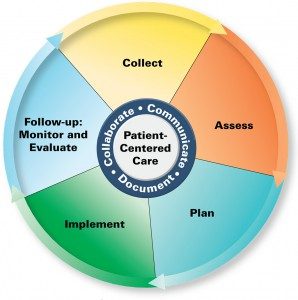 The multi-colored wheel shown here illustrates the patient-centered care process. Your pharmacist starts by learning about you (collecting information). The information may come directly from you, or from your health record if your pharmacist has access to it. Then, you and your pharmacist evaluate (assess) each medicine to see if it's effective, safe, and personalized to you. This is the time when any problems you're having (cost, side effects, and so forth) can be discussed. Together, you and your pharmacist (with the help of your doctor if needed) will make a plan to resolve any problems that came up during your discussion. This may include setting health-related goals as well as tracking progress toward those goals. Next, you'll put the plan into action (implement). You can continue to work with your pharmacist (follow up) to make sure the plan is working. If needed, you and your team can change the plan to help you meet your goals, and the process continues.
The process works best when you and your pharmacist have an ongoing relationship. That way, you can ask questions or discuss problems whenever they come up, and you can check in with your pharmacist regularly. If you find the plan isn't working, changes can be made and new goals set. This process is a great way to help you use your medicines more effectively and stay healthy!.
Who needs Pharmacist-Provided Medication Management?
Studies show that people begin to go off track with medications nearly as soon as they start taking them. Many people stop taking new medicines soon after starting them. Children, young adults, the middle-aged and the elderly all make mistakes with medicine or simply decide not to take it. Developing a relationship with your pharmacist early on allows you to talk openly about medicines. You can learn about risks and benefits of your medicine, changes in lifestyle that may decrease the need for meds, and talk openly about what's important to you. In short, the earlier you get to know your pharmacist and begin talking about your medications, the better!
Who pays for Medication Management Services?
In the community pharmacy setting, Medicare Prescription Drug Policies cover medication management for those who qualify. That's a start, but it only helps a small number of those who could benefit from it. Some other insurers, seeing the value pharmacists add to healthcare, are covering the service for more of their members. Some clinics have pharmacists on their medical team, and the pharmacist's time generally comes at no added expense to patients in these settings. Nursing homes generally include the cost of the pharmacist's services in the overall cost of medications.
But if you're not one of those whose insurance covers medication management, paying out of pocket is very likely still a winning strategy for you. Why? Because ongoing help from a pharmacist can add real value to your healthcare. Your health will improve, you'll understand the risks and benefits of your medicine, and you'll spend less money overall on your healthcare.
Independent Medication Management practices such as Better My Meds employ pharmacists to focus on medication use rather than medication sales, and they are slowly gaining traction as the value of pharmacist input becomes clearer. This type of practice offers a variety of services at different prices. Contact us to make your appointment today!